

Texas Home Maintenance Checklist — Season by Season
Generic home maintenance checklists are written for a climate Central Texas does not have. This one is built around what actually happens here: brutal summers on clay soil, a freeze that arrives once a year and occasionally arrives hard, and a cedar pollen season that punishes an unchanged filter. It also flags the tasks that stop being safe to do yourself as you get older.
By Drew Chandler — Home Accessibility & Project Coordination · Updated 2026-08-11
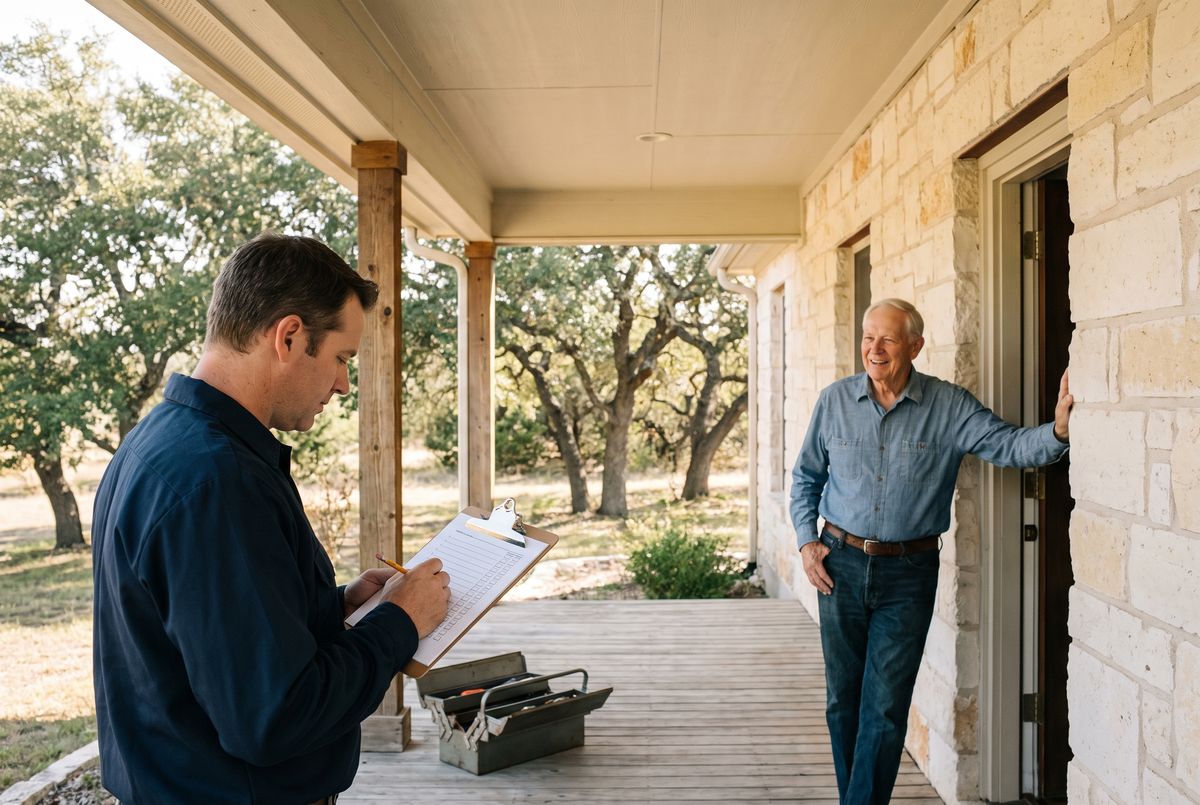
A Texas home maintenance checklist runs on three rhythms: monthly tasks, four seasonal blocks, and a short annual list. The Central Texas specifics that national checklists miss are servicing the air conditioner before summer, watering the foundation during summer drought because of the region's expansive clay soils, wrapping exposed pipes and covering hose bibs before the first hard freeze, and changing HVAC filters more often during cedar pollen season. Everything else — detectors, gutters, dryer vents, caulking, water heater — follows the standard schedule below.
Prefer not to keep track of it? The Live Oak Home Care Plan runs this checklist for you on a schedule, and sends a photo report to whoever in the family should see it. Or book a one-off seasonal upkeep visit and we will work the list once.
Why a Texas Home Maintenance Checklist Is Different
Four regional realities drive almost every difference between a Central Texas maintenance checklist and a national one: expansive clay soil that moves the foundation when it dries out, a cooling season long enough that an untended AC failure is a genuine emergency, an annual freeze risk that most homes here are not built for, and hard water from the region's limestone aquifers that shortens the life of water heaters and fixtures.
Take those one at a time, because each one changes when a task belongs on the calendar:
- Clay soil. Much of Central Texas sits on expansive clay that swells when wet and shrinks when it dries. In a long dry summer the soil pulls back from the slab edge, the foundation loses even support, and you start seeing doors that stick, drywall cracks at door corners, and trim separating. This is why foundation watering is a real summer task here and appears on almost no national checklist.
- A long cooling season. An air conditioner in this region runs hard for a large part of the year. Servicing it in spring — before the first stretch of triple digits — is not a nicety; it is the difference between a scheduled tune-up and an emergency call during the week every other house in the county is also calling.
- Freeze risk on homes not built for it. Pipes here are frequently run through attics, garages, and exterior walls with minimal insulation, because for most of the year that is fine. Once a winter, it is not.
- Hard water. Limestone aquifers leave mineral scale in water heaters, faucet aerators, and shower heads. Flushing the water heater annually and cleaning aerators is ordinary maintenance everywhere, but it pays off faster here.
Monthly Home Maintenance Checklist
Five things, once a month, in about fifteen minutes: test smoke and carbon monoxide alarms, check or change the HVAC filter, run water briefly in any unused sink or tub, look under sinks for drips, and walk the perimeter for anything obviously new — a stain, a gap, a loose board. Monthly checks exist to catch the cheap problem before it becomes the expensive one.
- Test every smoke and carbon monoxide alarm using the test button. Replace batteries on a fixed schedule rather than waiting for the low-battery chirp.
- Check the HVAC filter. During heavy cooling months and during cedar pollen season, expect to change it more often than the box says.
- Run water in guest bathrooms and unused drains so the P-trap does not dry out and let sewer gas into the room.
- Look under every sink with a flashlight. A slow drip found in month one is a washer; found in month twelve it is a cabinet floor.
- Walk the outside of the house once. You are looking for new stains, new gaps, wasp nests near doors, and anything blocking a dryer or attic vent.
Spring Home Maintenance Checklist
Spring is air conditioning season prep, and it is the single most important seasonal block in Central Texas. Service the AC before you need it, clear the condenser, check the drain line, inspect the roof and gutters after winter, and re-caulk anything the previous summer's heat opened up. Doing this in March and April is the whole point — in July, every HVAC company in the metro is booked.
- Have the air conditioner serviced. Book it early in the season. A tune-up now costs a fraction of a mid-August emergency call, and it is when a failing capacitor or low refrigerant gets caught cheaply.
- Clear the outdoor condenser unit. Two feet of clearance on all sides, no shrubs growing into it, and no grass clippings blown into the fins.
- Check the AC condensate drain line. A clogged line is one of the most common causes of ceiling and wall water damage in this region. Many homeowners flush theirs with a cup of distilled vinegar at the access tee each spring.
- Inspect the roof and clear the gutters after winter storms, before spring rain. See the note in which tasks stop being safe to do yourself before getting on a ladder.
- Re-caulk and re-seal. Check exterior door and window caulking, and the caulk lines in tubs and showers, for gaps opened up by the previous summer's expansion.
- Test the irrigation system zone by zone and fix broken heads before the water bill teaches you about them.
Summer Home Maintenance Checklist
Summer in Central Texas is about two things: keeping the cooling system running and keeping the foundation from drying out. Water the foundation consistently through drought, keep filters fresh while the system runs constantly, watch for the first signs of soil movement — sticking doors, new drywall cracks — and stay off the roof and out of the attic in the heat.
- Water the foundation during extended dry stretches. Soaker hoses placed roughly 12 to 18 inches out from the slab edge, run for a short time consistently rather than heavily and occasionally. The goal is even moisture, not saturation, and consistency matters far more than volume.
- Watch for early foundation-movement signs: doors that suddenly stick or will not latch, fresh drywall cracks running diagonally from door and window corners, and trim or brick separating. Catching these early gives you options.
- Change filters more often. A system running nearly continuously loads a filter far faster than the label assumes.
- Check the AC drain line again mid-season — this is when clogs actually show up, because this is when the system is producing the most condensate.
- Do not schedule attic or roof work in peak heat. Attic temperatures in a Central Texas summer are genuinely dangerous. Move those tasks to spring or fall.
Fall Home Maintenance Checklist
Fall is when freeze preparation actually happens — not the week of the freeze warning. Insulate exposed pipes, buy and fit hose bib covers, disconnect garden hoses, service the heating system, clear gutters after the leaves drop, and find your main water shut-off while it is still comfortable to be outside looking for it.
- Insulate exposed pipes in the attic, garage, crawlspace, and along exterior walls. Foam sleeves are inexpensive and the work is far easier in November than in a hurry in January.
- Cover every outdoor hose bib and disconnect and drain garden hoses. A hose left connected traps water against the spigot and is a common cause of a burst line.
- Locate and label your main water shut-off, and make sure everyone in the house — and anyone who checks on the house — knows where it is and can physically turn it. If it takes a special key, buy one now and hang it nearby.
- Service the heating system and run it once for a few minutes before the first cold night, so the burnt-dust smell and any failure happen on your schedule.
- Clear gutters and downspouts after the leaves finish dropping, and confirm downspouts discharge away from the foundation.
- Reverse ceiling fans to clockwise on low, which pushes warm air back down instead of creating a draft.
- Change filters for cedar season. Ashe juniper pollen peaks in Central Texas from roughly December through February, and it loads filters quickly.
Winter Home Maintenance Checklist
Winter here is mostly a watch-and-react season, built on work already done in fall. When a hard freeze is forecast: cover outdoor faucets, open cabinet doors under sinks on exterior walls, let a faucet drip, and know where the shut-off is. Between freezes, winter is the right time for indoor projects, attic work, and the roof inspection you could not safely do in August.
- Before a forecast hard freeze: confirm hose bib covers are on, open the cabinet doors under sinks on exterior walls so household heat reaches the pipes, let a faucet drip on the line farthest from the water main, and set the thermostat to hold a steady temperature rather than dropping overnight.
- If pipes do freeze, shut off the water at the main before thawing anything. Most burst-pipe damage happens at the moment of thaw, when water starts moving again through a split line.
- Do the cold-weather-friendly outdoor work that was unsafe in summer heat: roof inspection, attic checks, exterior painting and sealing.
- Test the water heater's temperature and pressure relief valve, and check for corrosion or moisture at the base.
- Keep filters fresh through cedar season — this is peak pollen, and it is also when the house is closed up most.
The freeze lesson worth keeping. February 2021's Winter Storm Uri produced 500,196 insurance claims in Texas — about 85% of them property claims, including burst pipes and roof damage — and an estimated $10.3 billion in total losses (Source: Spectrum News, reporting Insurance Council of Texas figures, January 2022). A great many of those homes had never frozen hard before. The practical takeaway most Central Texas homeowners drew from it is simply this: freeze prep is a fall checklist item, done annually — not an errand you run the afternoon a freeze warning posts, when the pipe insulation aisle is already empty.
Annual Home Maintenance Checklist
A handful of tasks only need doing once a year, and each one quietly prevents an expensive failure: flush the water heater, clean the dryer vent, inspect the roof, deep-check exterior caulking and weatherstripping, replace detector batteries on schedule, and service major appliances. Pick a month and attach them to it so the year does not simply pass.
- Flush the water heater. Hard water leaves sediment that reduces efficiency and shortens the tank's life. This is the highest-value annual task in this region.
- Clean the dryer vent along its full run, not just the lint trap. A restricted vent is both a fire risk and a reason dryers seem to "stop working."
- Inspect the roof for lifted or missing shingles, damaged flashing, and failing sealant at penetrations — ideally in cool weather.
- Walk the full exterior caulk and weatherstripping line around doors and windows, and reseal what has cracked.
- Replace smoke and CO detector batteries on a fixed annual date, and replace the detectors themselves per the manufacturer's expiration — typically about ten years for smoke alarms.
- Clean refrigerator condenser coils and check appliance hoses, especially the washing machine supply lines, for bulging or cracking.
Which Tasks Stop Being Safe to Do Yourself
Anything on a ladder, anything on the roof, and anything in the attic. Gutter clearing, roof inspection, high light bulbs, ceiling-return filters, and smoke detectors on tall ceilings are the checklist items that most often send an older homeowner to the emergency room. The tasks are routine — the ladder is the hazard, and it does not get less hazardous with practice.
This is the part of the checklist that matters most in our work, and the part families most often overlook. A parent who has changed their own filters for forty years does not necessarily stop when the ceiling return is at the top of a stairwell. The CDC reports that more than 1 in 4 adults 65 and older falls each year, and falls are the leading cause of both fatal and non-fatal injuries in this age group (Source: CDC, Older Adult Falls Facts & Stats).
A reasonable line to draw, and the one we use with our own clients:
- Hand off: gutters, roof, attic, anything requiring a ladder taller than a two-step, second-story window work, water heater flushing, and anything that requires kneeling on a hard surface and getting back up unassisted.
- Keep: testing detectors from the floor with a broom handle on the test button, monthly under-sink checks, running unused taps, perimeter walks, and thermostat and fan-direction changes.
- Decide case by case: filter changes at floor-level returns, hose bib covers, and irrigation checks — these depend far more on balance and knees than on age.
If a checklist item is on the hand-off list and there is no family member nearby to do it, that is precisely the gap a recurring maintenance plan or a scheduled handyman visit is meant to fill. It is also worth pairing with a room-by-room home safety review, which covers the fall hazards inside the house rather than the maintenance around it.
What Seasonal Maintenance Costs in Central Texas
A one-off seasonal upkeep visit in Central Texas typically runs $200 to $450, depending on the size of the list and the house. A recurring plan usually costs less per visit, because the home never falls behind — Live Oak's Seasonal Care starts at $245 per quarterly visit and Monthly Care at $185 per month, with the exact price confirmed in writing at a free baseline walk-through.
These are typical Central Texas ranges rather than quotes; the real number depends on your home and the checklist you actually want run. If you are weighing this against a home warranty, they are not competing products — a warranty reimburses certain repairs after a failure, while a maintenance plan is preventive work intended to reduce failures. For broader project pricing, our Central Texas cost guide covers accessibility and remodeling work.
Frequently Asked Questions
What should be on a Texas home maintenance checklist?
A Texas home maintenance checklist covers four seasonal blocks plus recurring monthly and annual tasks. The Central Texas specifics that generic national checklists miss are: servicing the air conditioner before summer rather than after, watering the foundation during summer drought because of the region's expansive clay soils, wrapping exposed pipes and covering hose bibs before the first hard freeze, and changing HVAC filters more often during cedar pollen season from December through February. Everything else — smoke and CO detectors, gutters, dryer vents, caulking, water heater flushing — follows the standard schedule.
How often should home maintenance be done?
Most home maintenance falls into three rhythms. Monthly: test smoke and carbon monoxide alarms, change or check HVAC filters, and run water in unused drains. Quarterly or seasonally: the four blocks of work timed to what the weather is about to do — spring, summer, fall, and winter prep. Annually: water heater flush, dryer vent cleaning, roof and gutter inspection, and a full exterior caulk and weatherstripping review. Skipping the seasonal rhythm is what turns small maintenance into large repairs.
When should I wrap pipes for a freeze in Central Texas?
Do the work in late fall, not on the day a freeze is forecast. Central Texas typically sees its first hard freeze between late November and early January, and hardware stores sell out of pipe insulation and faucet covers within hours of a freeze warning. Insulate exposed pipes in the attic, garage, and along exterior walls, cover every outdoor hose bib, disconnect and drain garden hoses, and locate your main water shut-off so you can find it in the dark. February 2021's Winter Storm Uri produced 500,196 insurance claims in Texas, about 85% of them property claims including burst pipes and roof damage, with an estimated $10.3 billion in total losses (Source: Spectrum News, reporting Insurance Council of Texas figures). Many of those homes had never frozen hard before — the lesson most Central Texas homeowners took from it is that preparation belongs on the fall checklist, every year.
Should I water my foundation in Central Texas?
Yes, during extended summer drought. Much of Central Texas sits on expansive clay soil that swells when wet and shrinks when it dries out. When the soil pulls away from the perimeter of a slab during a hot, dry stretch, the foundation loses uniform support and can move — which shows up as sticking doors, cracked drywall at door corners, and separating trim. Soaker hoses placed 12 to 18 inches from the slab edge, run briefly and consistently rather than heavily and occasionally, keep the moisture level even. The goal is consistency, not saturation.
Which home maintenance tasks should older homeowners stop doing themselves?
Anything on a ladder, anything on the roof, and anything in the attic. Gutter clearing, roof inspection, second-story light bulbs, HVAC filters in ceiling returns, and smoke detectors on high ceilings are the tasks that most often lead to a serious fall. The CDC reports that more than 1 in 4 adults 65 and older falls each year, and falls are the leading cause of both fatal and non-fatal injuries in this age group. The tasks themselves are routine; the ladder is the hazard. These are exactly the items worth handing to a maintenance plan, a handyman visit, or a family member.
How much does seasonal home maintenance cost in Central Texas?
A one-off seasonal upkeep visit in Central Texas typically runs $200 to $450 depending on the size of the list and the house. A recurring maintenance plan generally costs less per visit because the home never falls behind — the Live Oak Home Care Plan starts at $245 per quarterly visit for Seasonal Care or $185 per month for Monthly Care, with your exact price confirmed in writing at a free baseline walk-through. These are typical Central Texas ranges; a free in-home visit gives you an exact quote.
Is a home maintenance plan the same as a home warranty?
No, and they solve opposite problems. A home warranty reimburses certain repairs after something breaks, minus service fees and coverage exclusions. A home maintenance plan is preventive: a person visits on a schedule and works a written checklist so fewer things break in the first place. A warranty is a claims process; a maintenance plan is a standing appointment. Many families who care for an aging parent's home value the maintenance plan more, because it also puts a trusted, documented set of eyes in the house on a regular basis.
Let us run the checklist for you
The Live Oak Home Care Plan puts your home — or your parents' home — on a schedule instead of a worry list. The same local home-services team works a written seasonal checklist, handles the small fixes on the spot, and sends a photo report to the family after every visit. The baseline walk-through is free.
Clear Written Scope · home-accessibility · Family-owned in Driftwood · No long-term commitment, cancel anytime