Austin & Central Texas

Accessible bathroom remodeling

An accessible bathroom remodel addresses barriers such as high tub edges, narrow doorways and hard-to-reach fixtures. Options can include a curbless shower, a comfort-height toilet and properly anchored grab bars.

Start with a free in-home assessment to plan a bathroom that works for you. Your written scope and quote identify the work and each responsible provider.

Live Oak handles accessibility installations and routine upkeep within its direct scope. For plumbing, electrical, tile and structural work, the homeowner contracts with the appropriate trade partner. We help define the scope and coordinate the work.

home-accessibility · Clear Written Scope · Driftwood, TX

The bathroom is where most home falls happen. But it is also one of the places people most want to keep using on their own. The right design changes — a curbless shower, well-placed grab bars, a comfort-height toilet, slip-resistant flooring — can make that room feel safe again without making it look like a medical supply catalog.

We are a family-owned, home-accessibility focused remodeling company based in Driftwood, just south of Austin. We have worked in hundreds of Hill Country and Austin-area homes. We know how to blend function with the look you actually want.

  • One point of contact from first call through final walkthrough
  • Written fixed-price quote — no surprises on the invoice
  • We protect your floors and clean up completely every day
  • Written scope and warranty terms on every project

No obligation. We come to you, anywhere in the Austin metro, Hill Country, or Central Texas.

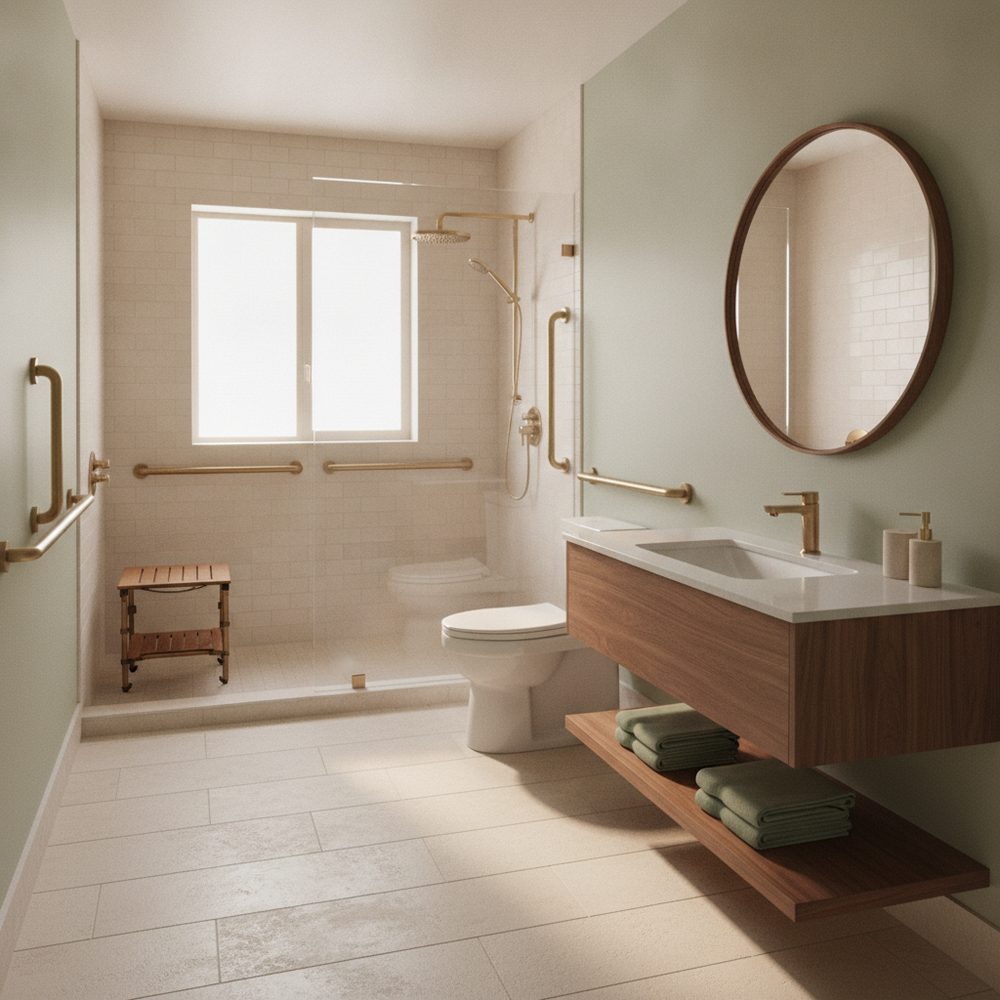
Completed accessible bathroom remodel home — curbless roll-in shower with fold-down bench, chrome grab bars, comfort-height toilet, and slip-resistant porcelain tile
Home Accessibility Project Planning

Is this the right time to remodel?

You do not have to wait for a crisis. Here are situations where our clients — and their families — say they wish they had called sooner.

You or your parent recently had a fall

A fall in the bathroom is often the event that makes a family take action. The good news: the changes that prevent a second fall are not dramatic. Grab bars at the right heights, a seat in the shower, a non-slip floor — these are targeted, affordable upgrades. We can assess the whole bathroom in one visit and prioritize what matters most.

After a stroke, surgery, or new diagnosis

Discharge planners and occupational therapists often hand families a checklist of home modifications. We are experienced at translating those clinical recommendations into real construction work — quickly, and without disrupting your recovery at home. Our design process is informed by OT best practices.

A wheelchair or walker is now part of daily life

Standard bathrooms are not built for mobility devices. Tight doorways, narrow turning radii, high tub lips, and slippery floors become real obstacles. A handicap accessible bathroom remodel — widened doorway, roll-in shower, grab bars at transfer height, clear floor space — changes that completely.

Balance issues, Parkinson's, or increasing unsteadiness

Progressive conditions call for proactive planning. We often work with clients who are managing well right now but want their bathroom set up so it stays safe as things change. That means thinking about future grab bar placement, curbless shower access, and lighting — not just today's needs.

Planning ahead while you still have choices

Many of our clients are in their late 60s or early 70s, completely independent, and simply want their home updated so they never have to move. Aging in place bathroom design done now — on your timeline, with your preferred finishes — is very different from a rushed project after an emergency.

Adult children helping a parent plan ahead

If you are researching this for your mom or dad, you are not alone. We work with adult children every day — often remotely at first, until we can coordinate a visit with the homeowner. We will take good care of your family.

What an accessible bathroom remodel can include

Every project is different. We scope each one around your bathroom, your budget, and your goals. These are the components we install most often — individually or as part of a full remodel.

Curbless & Roll-In Showers

No threshold to step over. A linear drain or recessed floor slopes the water away. We install fold-down teak benches, hand-held showerheads on slide bars, and pressure-balancing valves to prevent scalding. These are the centerpiece of most accessible bathroom remodels.

Learn about walk-in shower conversions →

Grab Bars & Safety Rails

We anchor bars directly into wall studs or install backing plates so they can hold the weight of a full adult. Placement follows OT and ADA guidelines — beside the toilet, inside and outside the shower, at transfer points. We offer chrome, brushed nickel, oil-rubbed bronze, and matte black to match your existing fixtures.

Learn about grab bars & bath safety →

Comfort-Height & ADA Toilets

Standard toilets sit at 15 inches. A comfort-height model sits at 17–19 inches — much easier to lower yourself onto and rise from, especially with arthritis or hip pain. We install the toilet, the surrounding grab bars, and make sure the swing of the door gives a full 60-inch turning radius for a wheelchair.

Learn about comfort-height toilets →

Non-Slip & Low-Threshold Flooring

Smooth, wet tile is one of the biggest fall risks in any bathroom. We replace it with slip-rated porcelain or luxury vinyl tile (LVT), both rated for wet areas. We also eliminate transitions and threshold lips that can catch walkers, canes, or shuffling feet.

Ask us about flooring options

Doorway Widening

Standard interior doors (28–30 inches) are too narrow for most wheelchairs. We widen openings to 32–36 inches clear, patch and refinish the surrounding drywall and trim, and hang a new door — often a barn-style or pocket door that removes the swing entirely and adds even more usable space.

Ask us about doorway widening

Lighting & Ventilation Upgrades

Good lighting matters more as vision changes. We add task lighting at the vanity and night lights near the toilet and shower. Better ventilation reduces moisture — and moisture is what makes tile slippery and grout fail over time. These are easy upgrades to add while we are already working in the space.

Ask us about lighting upgrades
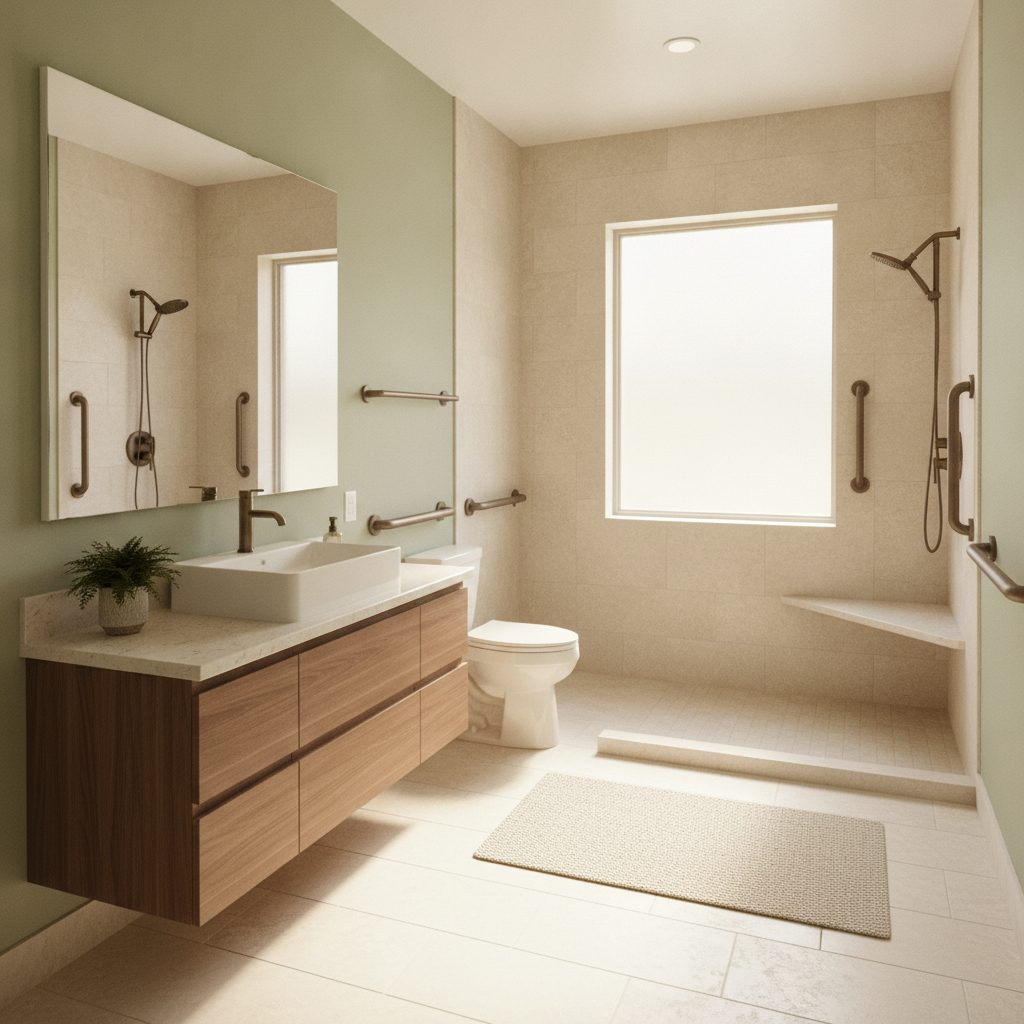
A finished ADA accessible bathroom remodel with a curbless shower, comfort-height vanity, and grab bars

ADA Bathroom Dimensions & Clearances for a Wheelchair Accessible Bathroom

Planning a wheelchair accessible or handicap bathroom? These are the key clearances from the 2010 ADA Standards. They are legally required only for public and commercial spaces — in a private home we apply them as best-practice guidelines, adapted to the person's height, reach, and equipment.

A wheelchair accessible bathroom needs a 60-inch turning circle, a clear floor space of 30 × 48 inches at each fixture, a doorway with at least 32 inches of clear width, a toilet set 16–18 inches (centerline) from the side wall with a 17–19 inch seat height, grab bars mounted 33–36 inches above the floor, a sink no higher than 34 inches with knee clearance beneath, and a roll-in shower at least 60 × 30 inches. A practical minimum room size for a full wheelchair-accessible bathroom is about 60 × 56 inches, though more space is always easier to use.

ADA bathroom dimensions (2010 ADA Standards) we apply as residential best practice
Element ADA dimension
Wheelchair turning space60-inch diameter circle, or a T-shaped turn within a 60 × 60-inch space
Clear floor space at each fixture30 × 48 inches
Doorway clear width32 inches minimum with the door open 90°
Toilet seat height17–19 inches to the top of the seat
Toilet centerline from side wall16–18 inches
Side grab bar at toilet42 inches long minimum, no more than 12 inches from the rear wall
Rear grab bar at toilet36 inches long minimum
Grab bar mounting height33–36 inches above the finished floor
Lavatory / sink rim height34 inches maximum
Knee clearance under sink27 inches high × 30 inches wide × 11–25 inches deep
Roll-in shower size60 × 30 inches minimum (or a 36 × 36-inch transfer shower)
Shower controls & hand-held sprayWithin the 48-inch forward/side reach range

ADA standards are legally required only for commercial and public buildings. In private homes we treat them as a starting point and tailor every dimension to the actual person — their height, reach, grip strength, and whether they use a walker, manual chair, or power wheelchair. The goal is a bathroom that is genuinely usable, not just code-shaped. Our Central Texas cost guide covers what these changes typically cost.

How we work — from first call to finished bathroom

We designed this process to be clear, low-stress, and respectful of your time and your home.

  1. Free in-home safety assessment

    We visit your home after confirming availability for your address and walk through the bathroom with you. We review the layout, listen to what feels difficult and discuss the changes you want to make. Online home-safety assessments reserve 90 minutes; a dedicated project quote visit reserves 2 hours. Review the visit type and time before confirming. There is no obligation to purchase work.

  2. Written fixed-price proposal

    Within a few days, we send you a detailed written proposal. It lists exactly what we will do, the materials we will use, the timeline, and the total price. The number you see is the number you pay — we do not add surprise charges at the end. We are happy to answer questions or adjust the scope before you sign.

  3. Confirm permit requirements

    Permit requirements confirmed with the responsible trade partner

  4. Professional installation — clean every day

    Our scheduled team protects your floors with drop cloths and corner guards, works methodically, and leaves the space tidy at the end of every workday. We do not disappear mid-project. Your project manager is reachable by phone or text throughout.

  5. Written responsibilities and support

    Your written scope identifies the work, the responsible provider and the applicable warranty terms. Live Oak installations and separately contracted partner work have separate responsibilities. Ask us to explain these before work begins.

What does an accessible bathroom remodel cost in Central Texas?

Costs depend on the scope of work, the size of your bathroom, and your material choices. Here is a general sense of typical Central Texas ranges.

Targeted safety upgrades — grab bars, a comfort-height toilet, a hand-held showerhead, and slip-resistant flooring — are the most affordable entry point. These individual improvements can be done for relatively little and make an immediate difference.

Tub-to-shower conversion with a curbless entry, fold-down bench, pressure-balancing valve, and grab bars is the most common full project we do. It falls in a mid-range price bracket that many families find manageable, especially when paired with available funding programs.

Full accessible bathroom remodel — gut and rebuild, including curbless shower, new flooring, comfort-height toilet, grab bars, widened doorway, vanity replacement, and lighting — is a more significant investment. The result is a bathroom that will serve you well for the rest of your life in this home.

We do not publish exact price ranges because the variables are too significant — your specific bathroom, your tile choices, whether plumbing or electrical needs to be relocated, and current material costs all play a role. Our Central Texas cost guide walks through the factors in detail.

The most accurate number comes from a free in-home assessment. We look at the actual space, take measurements, and build your quote from the ground up. Call us at (512) 222-8834 or request an assessment online — there is never a charge for this visit.


Funding help — you may not pay full cost out of pocket

Several programs can offset the cost of an accessible bathroom remodel. Here is what is most relevant for Central Texas homeowners.

  • Original Medicare generally does not cover bathroom modifications. Some Medicare Advantage plans offer limited home-safety benefits — verify your specific plan with your plan administrator.
  • VA HISA grant — the Home Improvements and Structural Alterations program helps eligible veterans pay for medically necessary home modifications. Verify current VA figures with your VA regional office, as grant amounts change.
  • Texas Medicaid STAR+PLUS HCBS waiver — the Minor Home Modifications benefit can cover accessibility work for qualifying Medicaid recipients in Texas.
  • Area Agency on Aging — local AAA programs sometimes have grant or loan programs for low-to-moderate income seniors. Check with the Capital Area AAA for Travis, Williamson, Hays, and surrounding counties.

We help gather documentation and complete program paperwork at no extra charge. We are not a medical, legal, or financial advisor — please verify current program details and eligibility requirements directly with each program.

Real projects — Central Texas homes

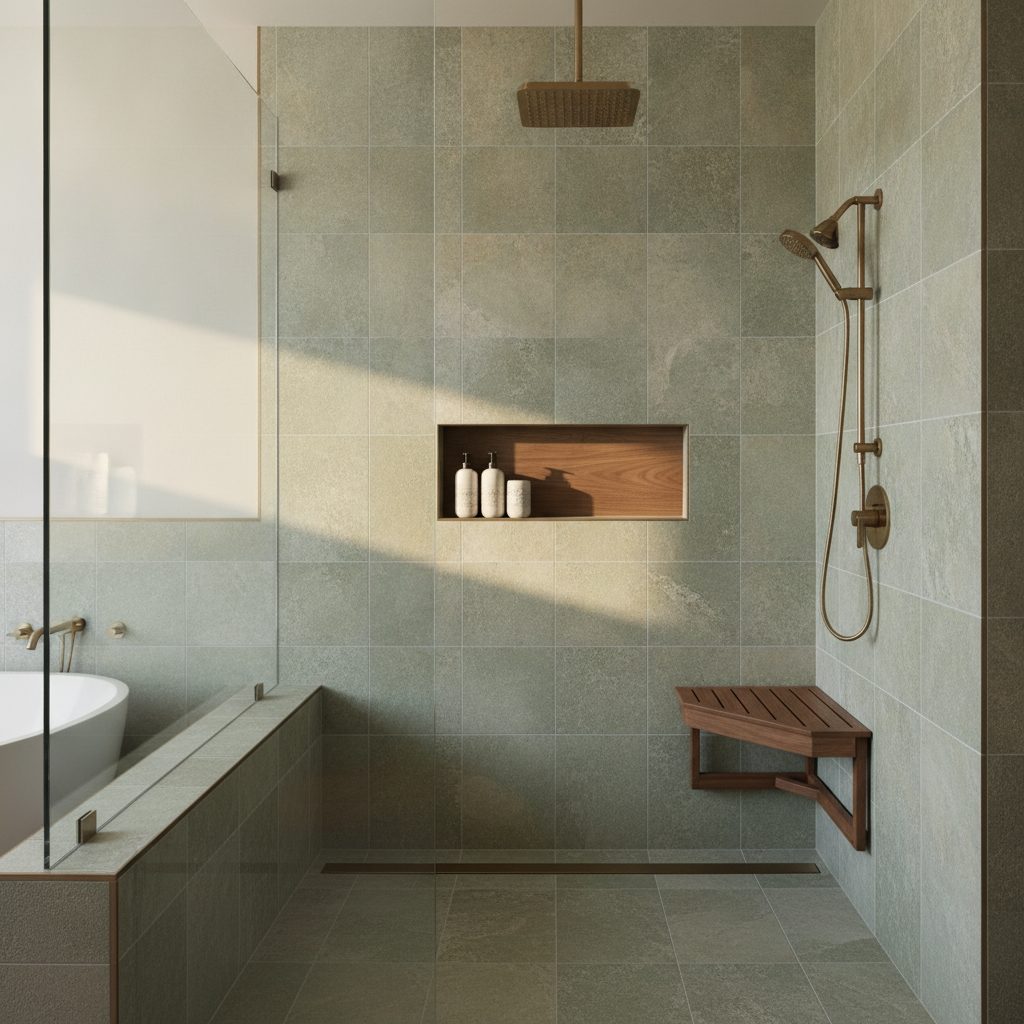
A completed roll-in shower with slate-look porcelain tile, a linear drain, and a fold-down bench home

Why the bathroom design matters as much as the hardware

We have seen accessible bathrooms that are safe but feel cold and institutional. We have also seen bathrooms that look beautiful but were not thought through — the grab bar is in the wrong spot, the shower bench is too high, the floor drain catches a cane tip.

We plan the work around the person’s daily routine, mobility equipment and the conditions in the home. Share any clinician recommendations you want included in the scope. Ask about the qualifications required for the proposed work.

And we think about aesthetics, because you are going to live with this bathroom for a long time. Stone-look porcelain. Warm wood-tone LVT. Matte black grab bars that blend with the fixtures. A fold-down bench that disappears when you do not need it. These details matter.

Questions about what might work in your bathroom? Call or text us at (512) 222-8834 — we are happy to talk through options before you commit to anything.

Why Central Texas families choose us

Home accessibility Specialist

We plan the work around the person’s daily routine, mobility equipment and the conditions in the home. Share any clinician recommendations you want included in the scope. Ask about the qualifications required for the proposed work.

Person-Centered Design

We work alongside occupational therapists and follow OT guidelines when positioning grab bars, setting shower bench heights, and planning transfer spaces. This means our installations match clinical best practices, not just building code minimums. If your doctor or OT has given you a recommendation list, bring it — we know how to execute it.

Project Qualifications & Coverage

Ask us about the coverage and qualifications relevant to your project. Your written scope identifies who performs the work and the applicable warranty terms. Live Oak handles home-accessibility installations and routine upkeep within its scope. For plumbing, electrical, tile and structural work, the homeowner contracts with the appropriate trade partner; we help define the scope and coordinate the work.

Family-Owned, Central Texas Local

We are not a franchise or a national chain. We are a local family-owned business headquartered in Driftwood, between Austin and the Hill Country. Drew Chandler, is personally involved in every project. When you call, you reach someone who knows your project — not a call center.

Scope & Warranty Terms

Your written scope identifies the work, the responsible provider and the applicable warranty terms. Live Oak installations and separately contracted partner work have separate responsibilities. Ask us to explain these before work begins.

Honest, Plain-Spoken Communication

We explain everything in plain language. You will never feel rushed or talked down to. We send written proposals so you can review at your own pace, and we are available by call or text when questions come up. This is a significant project — you deserve to feel completely comfortable before work starts.

Many accessible bathroom remodels include work from more than one of our service areas. Here is where to learn more.

Walk-In & Curbless Shower Conversions

Converting a tub to a curbless walk-in shower is the most impactful single change in most accessible bathroom remodels. Our dedicated shower page covers everything — drain types, bench options, glass enclosures, and tile selection. Not sure which design fits? See our curbless vs. roll-in shower guide.

Learn about shower conversions →

Grab Bars & Bathroom Safety

Proper grab bar placement is a science — the wrong height or angle does not provide the leverage people need. Learn about materials, finishes, blocking, and the OT-guided placement we use on every project.

Learn about grab bars →

Comfort-Height & ADA Toilets

A comfort-height toilet is one of the highest-impact, lowest-cost upgrades in any accessible bathroom. Our service page covers toilet height, bidet options, wall-hung models, and surrounding grab bar placement.

Learn about ADA toilets →

Central Texas Cost Guide

Our cost guide breaks down typical price ranges for every type of accessibility modification — from a single grab bar to a full accessible bathroom remodel — and explains the factors that affect your final number.

Read the cost guide →

Where we work

We serve the full Austin metro and surrounding areas. Our accessible bathroom remodel projects are especially popular in Georgetown and Sun City, where a large active-adult community calls us regularly. We also do significant work in Lakeway, Cedar Park, Round Rock, Kyle, Buda, Wimberley, Canyon Lake, New Braunfels, Marble Falls, and throughout the Kerrville and Fredericksburg corridor. From Driftwood — where we are based — we can reach most Hill Country and Central Texas communities within an hour.

Not sure if we serve your area? Call us at (512) 222-8834 or check our full service area map.

Frequently asked questions

How long does an accessible bathroom remodel take?

Most accessible bathroom remodels in Central Texas take between three and seven business days, depending on the scope of work. A tub-to-shower conversion with grab bars and a comfort-height toilet typically wraps up in three to four days. A full gut-and-rebuild with doorway widening and new flooring can take up to a week or more. We give you a firm timeline before work begins and keep you informed each day.

Do I need a permit for an accessible bathroom remodel?

It depends on the scope. Adding grab bars or swapping a toilet generally does not require a permit. Structural work — such as widening a doorway, moving plumbing, or altering load-bearing walls — typically does require a permit from your city or county. We handle all permitting on your behalf and make sure the work passes final inspection.

Will Medicare or insurance pay for an accessible bathroom remodel?

Original Medicare generally does not cover accessible bathroom remodels. Some Medicare Advantage plans offer limited home-safety benefits — verify your specific plan. VA HISA grants can help eligible veterans with the cost of medically necessary modifications. The Texas Medicaid STAR+PLUS HCBS waiver may also cover Minor Home Modifications for qualifying individuals. We help with the paperwork, but we are not a medical, legal, or financial advisor — please verify current program details with each program directly.

What is the difference between ADA-compliant and accessibility-focused remodeling?

ADA (Americans with Disabilities Act) standards are legally required for commercial and public spaces. For private homes, we apply those same clearances, fixture heights, and grab-bar specifications as best-practice guidelines for aging in place bathroom design. The result is a bathroom that works just as well for a homeowner using a walker or wheelchair as it does for any family member — without looking clinical.

Can you widen a bathroom doorway to fit a wheelchair?

Yes. Standard interior doors are 28–30 inches wide. A wheelchair typically needs at least 32 inches of clear opening, and 36 inches is ideal. We widen doorways and can also install offset hinges when full widening is not possible, which adds about two inches of clearance with minimal wall work.

How much does an accessible bathroom remodel cost in Central Texas?

Costs vary widely based on the scope of work, the size of your bathroom, and your material choices. Targeted upgrades — such as grab bars, a comfort-height toilet, and a hand-held showerhead — typically fall in a lower range, while a full accessible bathroom remodel including a curbless shower conversion, new flooring, and doorway widening runs considerably higher. Our Central Texas cost guide explains typical ranges in detail. The most accurate number comes from a free in-home assessment, which is always our first step.

What is the difference between a handicap bathroom and a wheelchair accessible bathroom?

The terms overlap, but they describe different levels of access. People often say "handicap bathroom" to mean any bathroom made safer with grab bars, a comfort-height toilet, and a no-step shower — improvements that help with balance, arthritis, or recovery. A "wheelchair accessible bathroom" goes further: a 32–36 inch doorway, a 60-inch turning circle, a roll-in shower, a roll-under sink, and at least 36 inches of clear floor space for transfers. We design either one — a targeted handicap bathroom upgrade or a fully wheelchair accessible remodel — around how you actually use the room today and how that may change.

What does good aging in place bathroom design actually look like?

Aging in place bathroom design means planning for how your body and needs may change over time — not just fixing today's problem. In practice that includes: a curbless shower entry so no step is ever required; grab bars positioned for both the shower and toilet transfer; a comfort-height toilet at 17–19 inches; at least 36 inches of clear floor space beside the toilet; a fold-down or built-in bench in the shower; slip-rated flooring throughout; lever-style faucet handles that work with limited grip; and lighting bright enough to see clearly at night. The goal is a bathroom that looks like a thoughtfully designed home — not a hospital room — and keeps working for you for decades.

What are the ADA dimensions for a wheelchair accessible bathroom?

Under the 2010 ADA Standards, a wheelchair accessible bathroom provides a 60-inch diameter turning circle (or a T-shaped turn in a 60 × 60-inch space), 30 × 48 inches of clear floor space at each fixture, and a doorway with at least 32 inches of clear width. The toilet sits with its centerline 16–18 inches from the side wall and a 17–19 inch seat height; grab bars are 33–36 inches above the floor, with a 42-inch side bar and a 36-inch rear bar. The sink rim is no higher than 34 inches with knee clearance beneath, and a roll-in shower is at least 60 × 30 inches. These ADA figures are required for public buildings; in a private home we apply them as best-practice guidelines tailored to the individual. See our ADA toilet height guide for a full breakdown of the 17–19 inch requirement and how it compares to a standard toilet.

What is the minimum size for a handicap accessible bathroom?

A practical minimum for a full handicap accessible bathroom with a roll-in shower is roughly 60 × 56 inches, because you need a 60-inch wheelchair turning circle plus 30 × 48 inches of clear floor space at each fixture. Smaller bathrooms can still be made much safer with a 36 × 36-inch transfer shower, a comfort-height toilet, and well-placed grab bars. The right layout depends on your existing walls, plumbing, and the equipment you use — we measure the actual room at a free in-home assessment and design to fit it.

Paying for the work

Not sure how you'd pay for it? Find out in minutes — free

Use the free Funding Check for a preliminary list of programs to review and questions to ask. Review the preliminary map with our team before making a funding or construction decision. Each program decides eligibility and approval. You can complete the check for yourself or, with permission, someone you support.

Book a time

Book a free visit — no obligation

Tell us what the visit should cover. Real open times appear on the next screen, nothing is charged and nothing is signed, and you keep whatever we put in writing.

What should the visit be about?
Anything else while we are there?

Optional requests are recorded for staff review. Only the primary visit reserves time; additional requests may need a separate appointment.

You choose the time on the next screen — nothing is booked by pressing this. No obligation; confirm availability and any travel terms before the visit. No work starts until you approve a written price.

Rather talk it through first?

Call or text and a real person picks up. We will answer questions about an accessible bathroom remodel — what it usually costs, how long it takes, whether it is even the right answer — without booking anything at all.

Call (512) 222-8834 Text us

Many families pair a project like this with the Live Oak Home Care Plan — scheduled visits from $185 a month, small fixes handled on the spot, and a photo report to the family after every one. Coordinating for a parent from out of town? Our guide for out-of-town family walks through how that works.

Ask us about the coverage and qualifications relevant to your project. Your written scope identifies who performs the work and the applicable warranty terms. Live Oak handles home-accessibility installations and routine upkeep within its scope. For plumbing, electrical, tile and structural work, the homeowner contracts with the appropriate trade partner; we help define the scope and coordinate the work.

Free · no obligation Written quote first Reschedule free

Ready to make your bathroom safer and easier to use?

A free in-home assessment is the best first step. We come to you, look at your bathroom, listen to your goals, and give you a clear picture of your options — and what they cost. No pressure, no obligation.

Or text us at (512) 222-8834 · Mon–Fri 8–6 · Sat 9–2 · Serving Austin, the Hill Country & Central Texas