

Accessibility Guide
Wheelchair Ramp Slope & ADA 1:12 Rule: A Homeowner's Guide
The 1:12 slope rule, landings, width, handrails, and Texas permitting — everything you need to plan a safe residential wheelchair ramp, in plain language.
By Drew Chandler — Home Accessibility & Project Coordination · Updated 2026-09-16
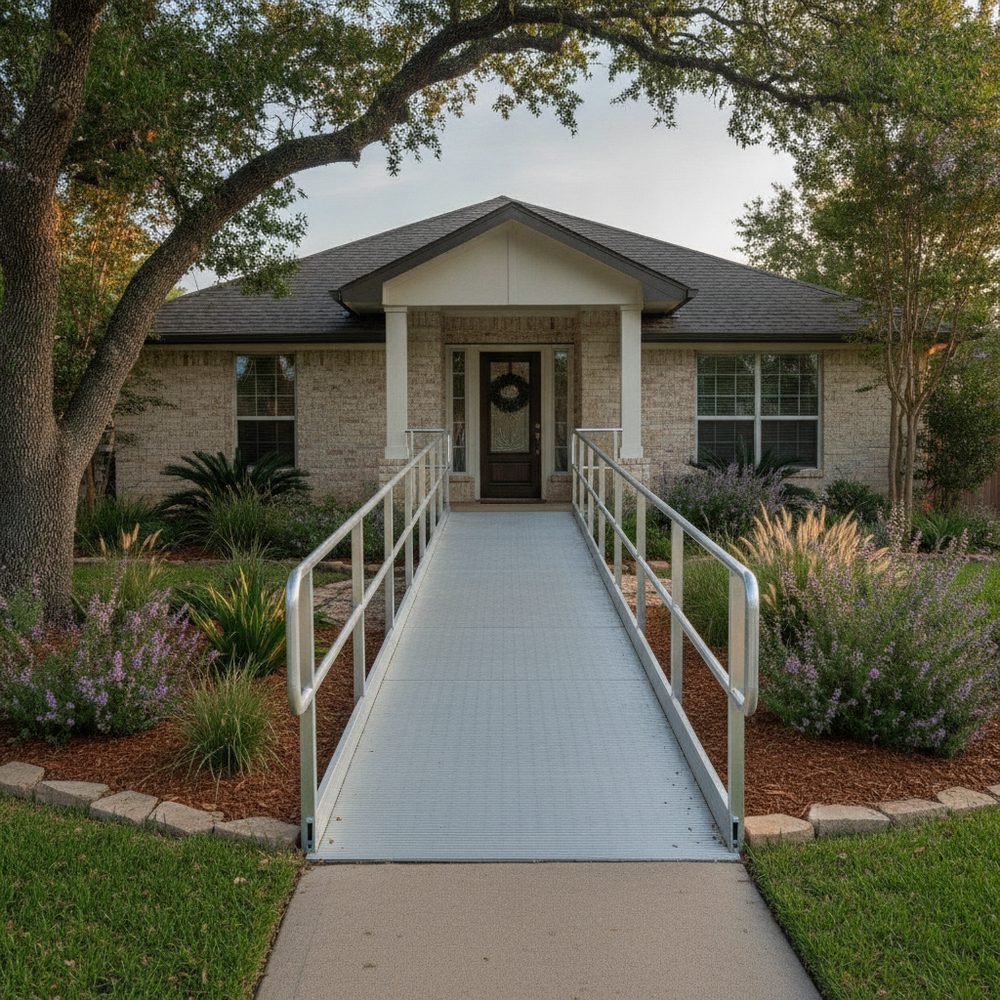
The standard wheelchair ramp slope is 1:12 — one inch of rise for every twelve inches of horizontal run. A 24-inch door threshold requires a ramp at least 24 feet long. For the ADA benchmark, level landings are at least 60 inches long and at least as wide as the ramp; turns need 60 × 60 inches. Graspable handrails are required on both sides when rise exceeds 6 inches. Confirm the applicable residential code and the user’s needs. These specs apply to ramps we build across Central Texas.
If your parent uses a wheelchair, walker, or power scooter, a well-built ramp is often the single change that lets them stay in the home they love. But slope is not the only thing that matters. A ramp that is too steep, too narrow, or missing a good landing at the top can be more dangerous than the steps it replaces. This guide walks through every dimension, explains where ADA and Texas residential code overlap, and tells you what to ask a contractor before the first board goes down.
Why Slope Is the Starting Point
Slope sets how much effort it takes to go up — and how much control a person needs coming down. A ramp that is too steep can tip a manual wheelchair or overwhelm a scooter's motor on descent. A gentler slope takes more space, and the whole route still needs suitable landings, surfaces and clearance.
The 1:12 ratio has been the gold standard in the ADA Standards for Accessible Design (§405.2) since the early 1990s. The math is simple: for every inch of vertical rise, the ramp runs 12 inches horizontally. In decimal terms, that is about 8.3% — the maximum usual ADA running slope. Individual ability and equipment still determine whether assistance or a gentler slope is needed.
Use 1:12 or gentler as the planning starting point, then assess the person, mobility equipment, landings, and available space. A powered chair does not make a steeper ramp safe automatically. ADA exceptions for existing sites are narrowly limited by rise and space constraints; they are not blanket permission for a 1:10 residential ramp. Confirm the design with the local permitting office and the equipment manufacturer.
The Core Specifications at a Glance
The table below summarizes the most important measurements, cross-referenced against ADA Standards for Accessible Design (which governs public accommodations and commercial buildings) and general best practice for private residences. Your local jurisdiction's residential code may differ — always confirm with your contractor and the permitting office.
| Dimension | ADA Standard (public/commercial) | Residential best practice |
|---|---|---|
| Maximum slope | 1:12 (8.3%) | 1:12 or gentler; confirm site, user, equipment, and local requirements |
| Maximum rise per run | 30 inches before required landing | 30 inches; design shorter runs when possible |
| Minimum clear width | 36 inches between handrails | 48–60 inches for comfortable two-person use |
| Landing size (top, bottom, turns) | 60 inches long, at least ramp width; 60 × 60 inches at turns | 60 × 60 inches minimum; larger where space allows |
| Handrails | Both sides; 34–38 inches above ramp surface; graspable | Both sides; graspable profile sized to the person and applicable code |
| Edge protection | Curb ≥4 inches, compliant barrier, or ≥12-inch surface extension beyond the handrail | Use the applicable edge-protection detail; a small decking overhang is insufficient |
| Surface | Stable, firm, slip-resistant | Broom-finish concrete, textured aluminum, or wood with anti-slip strips |
How Wide Should a Wheelchair Ramp Be?
A wheelchair ramp should be at least 36 inches wide between the handrails — the ADA minimum clear width — and 48 inches is the better target for most homes. The extra width lets a caregiver walk alongside, accommodates larger power wheelchairs and mobility scooters, and leaves room to correct a slightly off-center approach. For two-way traffic or the largest mobility devices, plan on up to 60 inches.
One detail trips people up: "clear width" means the usable space between the handrails or curbs — not the outside framing dimension. Handrails and edge curbs each eat into the deck, so a ramp framed at 42–44 inches may only offer 36 inches of actual clear path. Whenever you read a width figure, confirm whether it refers to clear width or overall structure.
| Situation | Recommended clear width |
|---|---|
| ADA minimum (single manual wheelchair) | 36 inches |
| Most homes — power chair or mobility scooter | 48 inches |
| Caregiver walking alongside the user | 48–60 inches |
| Two-way traffic or oversized mobility devices | 60 inches |
Width alone is not enough: the ramp still has to meet the 1:12 slope rule, and ADA landings are at least 60 inches long and as wide as the ramp. A change of direction needs at least 60 × 60 inches of clear landing space; door maneuvering clearance can require more. On the ramps we build across Central Texas, we measure the actual wheelchair or scooter on site, so the finished width fits the equipment and the household — not a generic catalogue spec.
Calculating Your Ramp Length: Step by Step
The math is straightforward once you have one measurement: the total rise. Here is how to work through it.
-
Measure the total rise
Stand outside the door. Measure from the ground level at the base of the entry to the top of the threshold — the flat part you step onto when you enter. Include any lip or weather seal. That number in inches is your total rise. A single exterior step is often 7 inches. A full porch may be 18 to 36 inches or more. Many Hill Country homes sit higher still.
-
Multiply rise by 12
Total rise (inches) × 12 = minimum ramp run (inches). Divide by 12 again to get feet. A 30-inch rise needs at least 30 feet of ramp. A 12-inch rise needs at least 12 feet. This is the horizontal distance from the base of the ramp to the point where it meets the landing at the top.
-
Add landing lengths
The total structure is longer than the run alone. Add at least 5 feet (60 inches) for the top landing and 5 feet for the bottom landing. If the ramp must turn — because the yard does not have a straight run — add another 5-foot landing at every direction change. A switchback design for a 30-inch rise might need 30 feet of ramp run plus three 5-foot landings, totaling around 45 linear feet of structure.
-
Decide on width
36 inches of clear width is the ADA floor. We recommend 48 inches for most residential ramps — it is much easier to maneuver, and a caregiver can walk alongside. If the person uses a wider power wheelchair or three-wheel scooter, your contractor will measure the chair and add clearance.
-
Check your available space
Walk the path from the front door to the driveway or sidewalk. Is there room for a straight run? Is there a flowerbed, AC unit, or meter in the way? Switchbacks, L-shapes, and curved ramps all solve space problems but add cost and complexity. A site assessment before design saves money later.
A small rise needs a longer path.
At a 1:12 slope, each inch of rise needs one foot of horizontal ramp run. Try a gentler slope to compare the space it takes.
Measure vertically from the ground to the entry level.
A gentler slope takes more space and can be easier to use.
Use a rise from 1 to 120 inches in half-inch increments.
Where the length goes
A length breakdown, not a site plan or a drawing of the slope.
Includes a 5-foot top landing and a 5-foot bottom landing. Turns and door clearance may need more space.
Example: a 24-inch rise at 1:12 needs 24 feet of ramp run, or about 34 feet with the assumed landings.
Planning comparison only. Displayed lengths round up to the next tenth of a foot. The length sum is not the yard footprint: turns, existing level surfaces, door clearance, drainage, equipment and applicable residential code change the design. The ADA benchmark allows no more than 30 inches of rise per ramp run. At 1:20, the route may be a walking surface rather than a ramp; this tool keeps the same conservative landing assumptions for comparison. Read the U.S. Access Board guide or ask us to assess the site.
Landings: The Detail That Most People Miss
Landings are the level platforms at the top, bottom, and any change of direction on a ramp. They do several important things:
- Give the person using the chair a place to stop, rest, and reposition before continuing.
- Provide enough space to turn the chair without going off the edge.
- Allow a caregiver to shift grip or adjust position safely.
- Satisfy fire and building codes that require an unobstructed area at doors (so the door can swing without hitting the chair).
The top landing must provide enough room to approach, open and pass through the door. Clearance depends on the approach direction, whether the person pushes or pulls the door, and its closer and latch. An 18-inch latch-side clearance is one ADA configuration, not a rule for every doorway. Keep the door swing away from the ramp landing where possible and confirm the full door maneuvering clearances during site design.
The bottom landing should be large enough that the chair stops on a level surface before the person rolls off onto uneven ground or a sloped driveway. If your driveway has a significant pitch, the contractor may need to create a small transition pad to bridge between the ramp and the pavement.
Handrails: Not Optional for Safety
ADA Standards for public buildings require graspable handrails on both sides of any ramp with a rise greater than 6 inches. Texas residential code thresholds vary by jurisdiction, but even when code does not strictly require them, handrails dramatically improve safety for most users.
For ADA applications, circular handrails have an outside diameter of 1¼ to 2 inches. Noncircular profiles have separate perimeter and cross-section limits. That size allows a person to fully wrap their hand around it. A flat 2×4 board is not graspable in the code sense and provides much less control. Handrails should be continuous along the full length of the ramp run, including the sloped section — not just at the landings.
Height matters too. ADA Standards place the top of the handrail at 34 to 38 inches above the ramp surface. At 34 inches, shorter individuals can reach comfortably. At 38 inches, taller users have better control on the way down. When building for a specific person, we measure their shoulder height and ergonomic reach to set the height that works best for them.
Handrail ends should be returned — bent down and into the wall or the post — so that clothing, bags, or canes do not catch on an open end. This is a small detail with a big impact on day-to-day safety.
Edge Protection and Surface
Where ADA edge protection is required, use a curb at least 4 inches high, a barrier that prevents a 4-inch sphere from passing, or a ramp surface extending at least 12 inches beyond the inside face of the handrail. A 2-inch curb or small decking overhang does not meet these details. See the U.S. Access Board edge-protection guidance and confirm the applicable residential requirements.
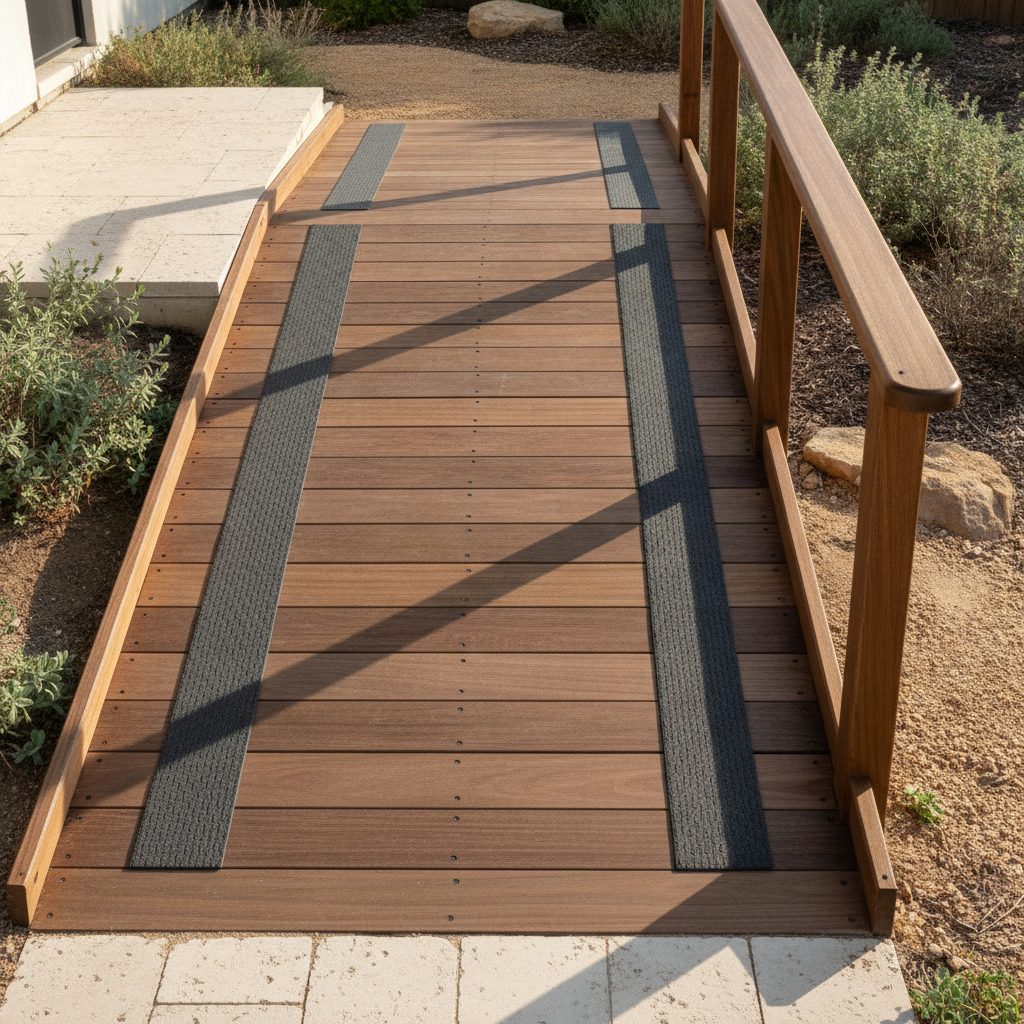
Surface texture is critical in Central Texas. Summer heat makes many surfaces slippery when combined with sweat or brief afternoon rain. Winter ice, though rare, can glaze any smooth surface. Good options include:
- Pressure-treated lumber with aluminum oxide anti-slip tread strips adhered across the width every 12 inches.
- Composite decking with a textured, co-extruded surface — low maintenance and holds up to UV exposure.
- Aluminum modular systems with a diamond-pattern, anodized surface — excellent grip even when wet.
- Concrete with a broom finish or aggregate surface — highly durable but requires more labor and a longer build time.
We protect your existing floors and landscaping throughout the build, and we clean up every day before we leave. That is our standard practice on every project.
Permitting in Texas: What to Expect
Permitting rules for residential wheelchair ramps vary across Central Texas. Here is a general picture — always confirm with your local jurisdiction, because rules change.
Permanent ramps attached to the home's structure (attached to ledger boards, footings in the ground, or framing tied into the house) almost always require a building permit in Texas municipalities. The permit process involves a plan review and a field inspection after the structure is built. Review times depend on the jurisdiction and proposed work.
Detached or modular ramps that rest on the ground without being anchored to the home are sometimes exempt from permitting in unincorporated county areas and some smaller cities. Even when exempt, they must still meet safety standards for their construction.
HOA approval may be required in many Central Texas communities, particularly in newer developments around Dripping Springs, Georgetown, Kyle, and Buda. We can help you draft a request to your HOA — accessibility modifications have federal fair housing protections that HOAs must respect under the Fair Housing Act.
Permit and inspection requirements depend on the address and proposed work. The trade partner you contract with confirms the required permits and handles them for its scope. Live Oak helps define the project and coordinate the work; confirm any HOA approval requirements before starting.
Material Options and Typical Central Texas Cost Ranges
Costs vary significantly based on rise, length, material, site conditions, and whether the project requires landing additions or landscaping adjustments. The table below compares relative cost levels. An in-home assessment helps define the scope needed for a written proposal.
| Ramp type | Relative cost | Notes |
|---|---|---|
| Wood (pressure-treated), short run under 10 ft | Lowest | Single step or low entry, basic handrail |
| Aluminum modular system | Low to mid | Faster install; portable if needs change; low maintenance |
| Wood, medium run 10–20 ft with landing | Mid-range | Standard porch height; includes landing and handrails |
| Wood or composite, long run >20 ft or switchback | Upper-mid | Higher entry or constrained yard; extra landings |
| Concrete ramp with poured footing | Highest (varies) | Most permanent; ideal for garages and heavy traffic |
Relative cost only — we do not publish fixed dollar figures because every ramp is different. Your quote depends on your home's specific rise, available space, soil conditions, material preferences, and permit fees. We provide a written estimate before any work begins — no surprises. See our Central Texas cost guide for how these factors add up.
How to Pay for a Wheelchair Ramp in Texas
Several programs may help offset the cost. See our full Texas home modification funding guide for detailed instructions on each program. A quick overview:
VA HISA Grant: The VA Home Improvements and Structural Alterations (HISA) benefit helps veterans with service-connected and certain non-service-connected disabilities make medically necessary modifications, including ramps. Verify current benefit amounts and eligibility at benefits.va.gov.
Texas Medicaid STAR+PLUS HCBS Waiver: The Home and Community Based Services (HCBS) waiver under STAR+PLUS can cover Minor Home Modifications for eligible Medicaid members with physical disabilities.
Medicare Advantage: Original Medicare generally does not pay for ramps. Some Medicare Advantage plans offer limited home-safety benefits — verify your specific plan's benefit summary.
Area Agency on Aging: The Capital Area Council of Governments (CAPCOG) and Hill Country Mental Health and Developmental Centers serve Central Texas seniors with information on local grant and loan programs.
We help gather documentation and paperwork. This is not medical, legal, or financial advice — verify current program details with the relevant agency before counting on any benefit.
Learn more about each option — including how to apply and what documentation you need — in our complete funding guide for Texas homeowners.
How We Build a Wheelchair Ramp in Central Texas
Every ramp project starts with a free in-home assessment. We walk the entry with you, measure the rise, assess soil and drainage, note the door swing and threshold, look for obstacles, and ask about the specific mobility equipment you or your family member uses. We take measurements of the wheelchair or scooter if available.
Then we design a ramp that fits the actual space — not a generic drawing from a catalogue. We discuss material options, show you how the finished ramp will look, provide a written estimate, and explain the permit process.
Your written scope identifies the installer, materials, applicable permits and inspection responsibilities. Structural work is performed by the appropriate trade partner under its own homeowner contract. We help coordinate the plan and handoff.
Our full wheelchair ramp service page explains the process in more detail, including how we handle switchback designs for homes with significant rise or limited yard space.
Ask us about the coverage and qualifications relevant to your project. Your written scope identifies who performs the work and the applicable warranty terms. Live Oak handles home-accessibility installations and routine upkeep within its scope. For plumbing, electrical, tile and structural work, the homeowner contracts with the appropriate trade partner; we help define the scope and coordinate the work.
Frequently Asked Questions
What is the ADA wheelchair ramp slope ratio?
The ADA standard for wheelchair ramp slope is 1:12 — meaning 1 inch of rise for every 12 inches of horizontal run. This gives a slope of roughly 4.8 degrees or about 8.3%. This is a maximum design slope, not a guarantee that every person can use the ramp without assistance. A powered chair does not establish that a steeper slope is suitable. Confirm local requirements, manufacturer limits, and the individual's abilities; a gentler ramp may be needed.
Is there a wheelchair ramp slope calculator?
Yes. The ramp length calculator compares slopes of 1:12, 1:16 and 1:20. Enter a rise from 1 to 120 inches to see the horizontal run, grade and an estimated length including the stated landing assumptions. For a 24-inch rise at 1:12, the run is 24 feet; adding two 5-foot landings gives 34 feet. The tool adds intermediate landings above 30 inches of rise. This is a planning comparison, not a site plan, code approval or a determination that a design fits the person’s needs.
How long does a wheelchair ramp need to be for a 24-inch rise?
Using the 1:12 rule, a 24-inch rise requires a minimum ramp run of 24 feet (288 inches). That is a single straight run. If your yard does not have 24 feet of space in one direction, a switchback design with an intermediate landing can keep the footprint smaller. Your contractor will measure your specific site and design the ramp to fit the space and meet code.
Does a residential wheelchair ramp in Texas need a permit?
In most Texas cities and counties, a permanent wood or concrete ramp attached to the home requires a building permit. Some jurisdictions exempt small portable or modular ramps. Requirements differ between municipalities — for example, Austin, Dripping Springs, Georgetown, and unincorporated county areas all have their own rules. A licensed contractor familiar with your jurisdiction will know what is required and can pull the permit on your behalf.
What width should a wheelchair ramp be?
ADA guidelines specify a minimum clear width of 36 inches between handrails. However, most builders recommend 48–60 inches for residential ramps. A wider ramp is much easier to use with a power wheelchair or mobility scooter, and it allows a caregiver to walk alongside the person using the ramp. If you use a larger electric scooter or three-wheel chair, your contractor will measure the equipment and design accordingly.
Can Medicare or Medicaid pay for a wheelchair ramp?
Original Medicare generally does not cover wheelchair ramps. Some Medicare Advantage plans offer limited home-safety benefits — verify your specific plan. Veterans may qualify for the VA HISA (Home Improvements and Structural Alterations) grant for medically necessary ramps — verify current VA figures at benefits.va.gov. Texas Medicaid STAR+PLUS HCBS waiver can cover Minor Home Modifications for eligible members. We help gather paperwork, but this is not medical, legal, or financial advice — verify current program details with the relevant agency.
What materials are best for a wheelchair ramp in Central Texas?
Central Texas heat, humidity, and occasional ice mean your ramp material matters. Pressure-treated lumber with aluminum oxide anti-slip strips is cost-effective and common. Aluminum modular systems are low-maintenance, light, and non-slip when textured — good for rentals or situations where the ramp may move later. Concrete offers permanence and handles Texas heat well but requires more labor. All options can be built to the 1:12 slope. We evaluate your site, your equipment, and your long-term plans before recommending a material.
How steep is too steep for a wheelchair ramp?
ADA ramp runs generally have a maximum slope of 1:12. Limited existing-site exceptions allow up to 1:10 for a rise of at most 6 inches, or up to 1:8 for a rise of at most 3 inches, where space limitations make that necessary. These exceptions do not establish what is safe for a particular wheelchair user. For a private home, confirm local code, equipment limits, and the person's needs before selecting a slope; use 1:12 or gentler as the planning starting point.
Not sure how you’d pay for it? Find out in minutes — free
Answer a few questions to explore programs that may fit your situation. Your Funding Map is a starting point; the program administrator confirms eligibility, available funds and approval. Check the result page for the status of your request and email.
Ready to Plan Your Ramp? Start with a Free Assessment.
We visit your home, measure the rise, assess the space, and give you a written design and estimate — at no cost and no obligation. Serving Austin, Dripping Springs, Georgetown, Marble Falls, Wimberley, Kyle, and the greater Central Texas Hill Country.
Questions first? Call or text us: (512) 222-8834 or send a text. We answer quickly during business hours.
Clear Written Scope · home-accessibility · Family-Owned · Driftwood, TX