

Curbless & Roll-In Showers Explained
Zero-entry, barrier-free, roll-in — the names can be confusing. This plain-language guide explains each term, the design details that make these showers work safely, and what to expect from an installation in a Central Texas home.
By Drew Chandler — Home Accessibility & Project Coordination · Updated 2026-08-03
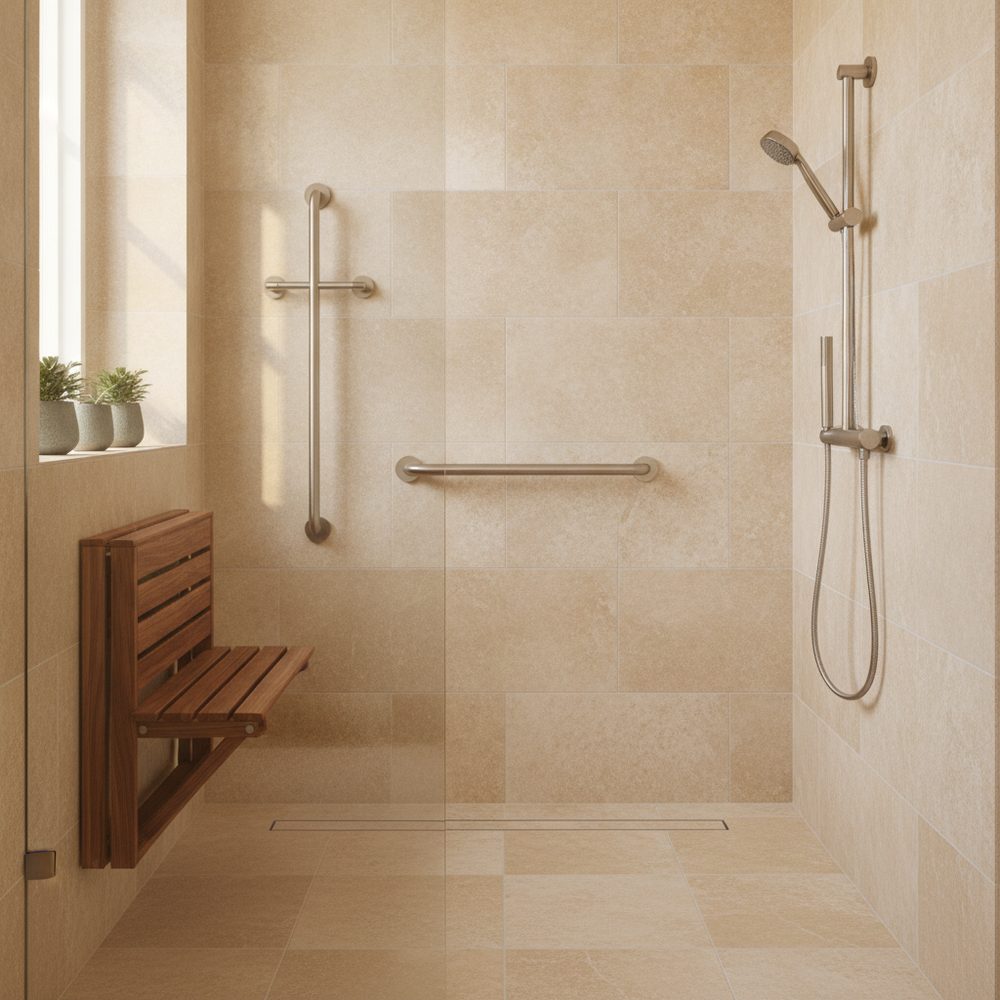
Curbless describes an entrance without a raised curb. A roll-in shower also needs the compartment dimensions, adjacent clearances and features that support wheeled access. Review the whole layout with the person’s equipment and any caregiver assistance in mind.
The Terms, Untangled
If you have been searching for information on safer showers, you have probably seen four or five different names that seem to mean the same thing. Here is what each one actually means — and where the distinctions matter.
| Term | What it means | Key requirement |
|---|---|---|
| Curbless shower | No raised curb or threshold at the shower entry | Sloped floor drains correctly; waterproofing extends beyond wet zone |
| Zero-entry shower | Another name for a curbless shower — zero height to step over, also written "zero entry shower" | Same as curbless |
| No-threshold shower | Same idea stated differently — there is no threshold (curb) at the entry; common search term for a curbless/zero-entry shower | Same as curbless: floor drains correctly with no raised lip to trip on |
| Barrier-free shower | Emphasizes that all physical barriers to entry have been removed | No curb, no door track at floor level, smooth transition |
| Roll-in shower | Curbless shower large enough for wheelchair access and maneuvering | Standard ADA roll-in compartment: at least 30 in. by 60 in., plus required adjacent clearance |
| Walk-in shower (accessibility sense) | Often used as a synonym for curbless or zero-entry | No threshold; may or may not be sized for wheelchair use |
The practical takeaway: if your goal is to stay safe as you age but you do not use a wheelchair, a curbless or zero-entry shower may be all you need. If you use a power or manual wheelchair — or want the bathroom to be ready if you ever do — a true roll-in shower with adequate square footage is the right goal.
Why the Step-Over Matters So Much
The traditional shower pan has a curb — typically three to five inches tall — that keeps water inside. That small step seems trivial. But for an older adult, someone recovering from surgery, or anyone with reduced leg strength or balance, lifting one foot over a wet curb while standing on one leg is one of the riskiest movements in the home. A CDC-published national study found an estimated 234,094 nonfatal bathroom injuries among people 15 and older were treated in U.S. emergency departments in 2008 — 81% caused by falls — and bathing, showering, or getting in or out of the tub or shower was the activity underway in 37% of all bathroom injuries, the single most common cause. (Source: CDC, Nonfatal Bathroom Injuries Among Persons Aged ≥15 Years, MMWR 2011)
Eliminating the curb removes that hazard entirely. Combined with strategically placed grab bars installed at the correct heights, a curbless or roll-in shower transforms the bathroom from a danger zone into a room where you can bathe with confidence.
Who Benefits From a Curbless or Roll-In Shower
These designs are not just for people with significant mobility limitations. They are practical for a wide range of situations:
- Adults aging in place who want to be proactive — making the modification now, before a fall or diagnosis, is easier and less disruptive than doing it in an emergency.
- People recovering from hip or knee replacement surgery, where stepping over a curb is temporarily painful or dangerous.
- Wheelchair and walker users who need a fully accessible shower with enough room to maneuver.
- People with balance or vertigo conditions, including those with Parkinson's disease, stroke survivors, or those with inner-ear disorders.
- Caregivers assisting a family member — a roll-in shower with a fold-down bench and a handheld showerhead makes assisted bathing significantly safer for both the person being helped and the caregiver.
- Anyone who simply prefers a cleaner, more open bathroom aesthetic — curbless showers are also popular in luxury design because they look beautiful and are easier to clean.
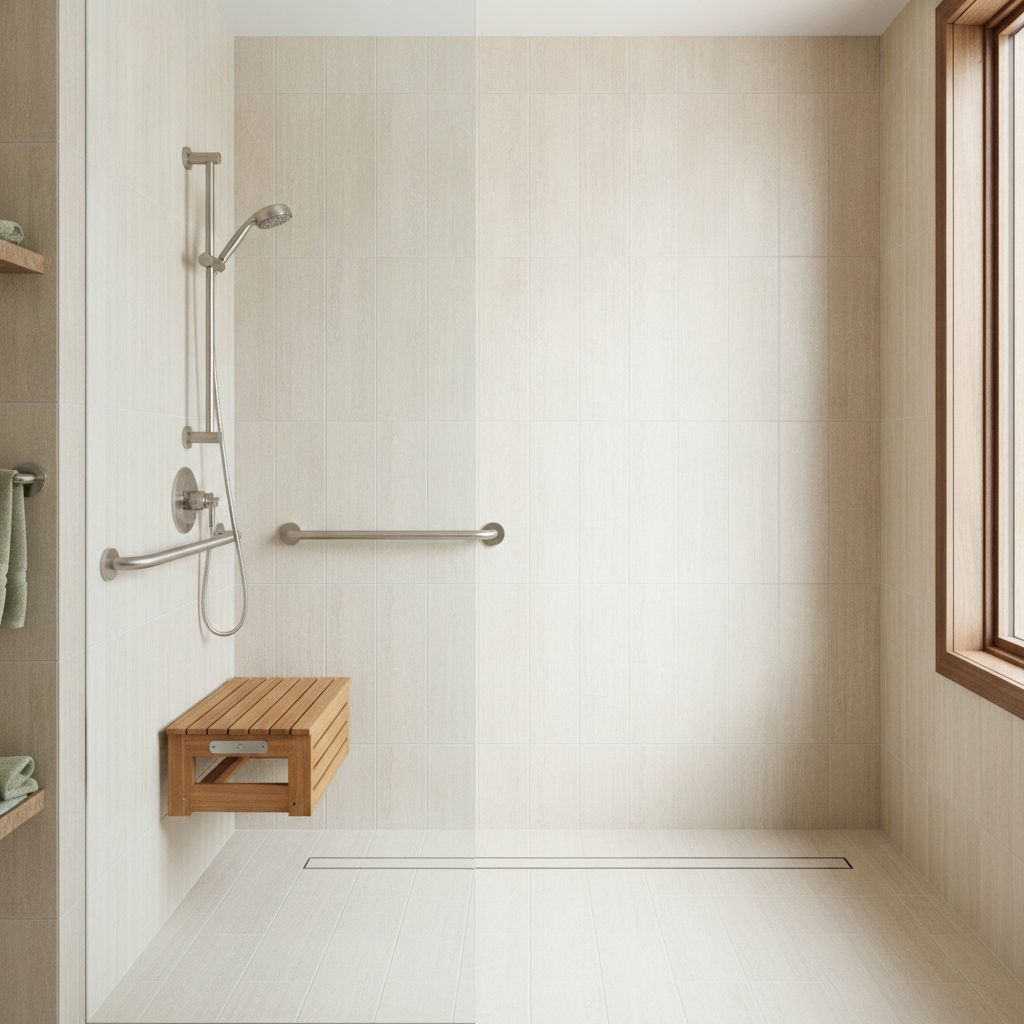
Design Elements: What Makes a Curbless Shower Work
A curbless shower is not simply a regular shower with the curb removed. Done wrong, water ends up on the bathroom floor, and eventually in the subfloor or the room below. Done right, these showers are watertight, comfortable, and beautiful. Here are the key design elements.
1. Slope-to-Drain: Getting the Pitch Right
Water only flows downhill. In a standard shower with a curb, a small amount of imprecision in the floor slope is forgiven — the curb catches anything that goes astray. In a curbless shower, the floor must slope accurately and consistently toward the drain so that water never migrates toward the bathroom floor.
The standard slope for a shower floor is approximately one-quarter inch of drop for every foot of horizontal distance. In a 36-inch-wide shower, that means the far wall is about 3/4 inch higher than the drain side. The slope must be consistent across the entire floor — no flat spots or dips where water can pool.
This level of precision requires either a carefully prepared mud-set mortar bed (the traditional method) or a purpose-made sloped shower base with the pitch built in. Both approaches work well in the hands of an experienced installer.
2. Linear Drains: The Preferred Choice for Accessible Showers
A traditional center drain requires the floor to slope inward from all four directions — four separate slopes meeting at a single point. This is technically demanding and creates a floor with a noticeable concave shape. That concave surface can feel unstable underfoot and makes large-format tiles difficult to install cleanly.
A linear drain is a long, channel-style drain placed along one wall — often the entry wall or the back wall of the shower. Because the drain runs the full width of the shower, the floor only needs to slope in one direction, creating a single flat plane. This offers three advantages:
- The floor surface is flatter and more stable — important for anyone with balance concerns or for wheelchair users whose wheels need consistent contact.
- Large-format tiles (12x24, 24x24, or larger) can be laid with minimal cuts and fewer grout lines, which are easier to clean.
- Linear drains are visually elegant and can be concealed beneath a tile insert that blends with the floor pattern.
For these reasons, linear drains are considered best practice for accessible shower design and are used in nearly all of our roll-in shower projects.
3. Waterproofing: The Most Critical Step
The waterproofing system is invisible once the tile is installed, but it is the most important element of the entire project. A failed waterproof membrane is the leading cause of water damage and mold in curbless showers.
In a standard shower with a curb, the membrane only needs to contain water within the shower footprint. In a curbless shower, the membrane must extend well beyond the wet zone — typically at least 12 inches beyond the shower opening onto the main bathroom floor — to catch any water that splashes or migrates during use.
Modern waterproofing systems for curbless showers typically use one of these approaches:
- Sheet membranes — flexible fabric- or foam-backed sheets bonded to the substrate with thin-set mortar. Brands such as Schluter KERDI are widely specified for accessible showers because the system is dimensionally consistent and has been extensively tested.
- Liquid-applied membranes — a pourable or brushed coating that cures to form a continuous waterproof barrier. These work well for complex geometries and can be faster to install, but require careful thickness control.
- Pre-sloped foam shower pans — factory-made foam bases that arrive with the correct slope already built in and a bonded surface membrane. These combine the mud-bed and waterproofing steps and are popular for retrofit projects where speed matters.
No matter which system is used, the installer must follow manufacturer specifications precisely. Shortcuts here — thin spots in the membrane, unsealed corners, inadequate overlap at seams — can lead to water intrusion that is invisible for years before causing serious structural damage.
4. Shower Floor Tile: Slip Resistance Matters
Ask the manufacturer whether the tile is suitable for the intended shower-floor use. Texture, drainage, grout joints, cleaning and conditions of use also matter. A wet DCOF of 0.42 is not a universal shower-floor safety threshold. See ANSI A326.3, published by TCNA.
Practically speaking, this means:
- Small mosaic tiles (1x1 or 2x2 inch) are inherently slip-resistant because the many grout lines provide grip — but they also have more grout lines to clean.
- Larger tiles can be slip-resistant if they have a matte, textured, or stone-finish surface. Highly polished large tiles are generally not appropriate for shower floors.
- Porcelain and ceramic tiles labeled "floor tile" and rated for wet areas are the most common choice. Natural stone (slate, travertine, rough-finish marble) can work well but requires sealing.
Our team evaluates tile slip resistance as part of every shower design. We will never specify a tile for your shower floor that we would not feel confident standing on wet.
5. Glass Enclosures vs. Open Showers
One of the design decisions for a curbless shower is whether to enclose it with glass or leave it partially open.
Open (doorless) designs maximize accessibility — there is no door to open and no threshold in any direction. Water containment relies entirely on the slope, the drain, and a sufficiently large wet zone. A doorless shower typically needs to be at least 36 inches deep (preferably 48 inches or more) so that spray from the showerhead does not reach the opening. A thoughtfully angled showerhead and a hand-held showerhead on a sliding bar help direct water away from the opening.
Glass panel or door enclosures help contain water and reduce the size requirements. For curbless showers, the glass must mount directly to the floor with no bottom track (or with a flush-mounted channel that does not create a raised threshold). Frameless glass panels and pivot doors are common choices because they eliminate the aluminum bottom rail that can itself become a trip hazard.
For roll-in showers, an open or panel design is usually preferred because it allows the easiest possible wheelchair entry and caregiver access.
6. Seating: Bench vs. Fold-Down Seat
Every accessible shower should include a place to sit. Bathing while seated is safer for anyone with limited stamina, balance challenges, or lower-body weakness. Two common options:
- Built-in tiled bench — a permanent seat built from the same materials as the shower walls, typically 17–19 inches high (consistent with ADA guidelines). Durable and visually integrated, but fixed in place.
- Fold-down shower seat — a wall-mounted seat that folds flat against the wall when not in use. Ideal when space is limited or when the shower is shared by users with different needs. These seats are rated for appropriate weight loads and must be mounted into structural blocking in the wall.
We always install structural backing (blocking) in shower walls during construction so that a fold-down seat, grab bars, or a shower bar can be added later without opening the wall.
Size Requirements: How Big Does It Need to Be?
The right size depends on who will use the shower and how.
| User situation | Minimum recommended size | Notes |
|---|---|---|
| Aging in place, no wheelchair | 30 in. × 60 in. for the standard ADA roll-in type | Comfortable for solo use with grab bars and bench; allows some maneuvering room |
| Walker user | 36 in. × 48 in. | Allows walker to enter; fold-down bench recommended |
| Manual wheelchair user, independent | 36 in. × 60 in. | Allows forward entry and turning; transfer bench at entry useful |
| Power wheelchair or attendant-assisted | 60 in. × 60 in. or larger | Full turning radius for many power chairs; room for caregiver alongside |
These are guidelines, not absolute rules. Your specific wheelchair model, the way you transfer, and the layout of your existing bathroom all affect what will work best. We assess all of these factors during a free in-home visit before recommending a design.
What About Waterproofing Transition to the Bathroom Floor?
This is the detail that separates a well-built curbless shower from one that causes problems. At the shower entry, the shower floor and the bathroom floor must meet at the same height — that is the whole point of a curbless design. But the shower floor is wet, and the bathroom floor is (ideally) dry. Managing that transition correctly requires:
- Setting the shower floor slightly lower than the bathroom floor — sometimes just a few millimeters — so that any water at the threshold flows back into the shower rather than out onto the bathroom floor.
- Extending the waterproof membrane from the shower floor out onto the bathroom floor for a minimum of 12 inches.
- Using a continuous tile installation across the threshold with no gaps in the grout or the setting bed.
- In some designs, a very shallow linear drain or a narrow channel at the threshold acts as a secondary catch for any water that reaches the entry.
In homes built on slab foundations — which is common in Central Texas — the bathroom subfloor height is fixed. Lowering the shower floor relative to the bathroom floor may require cutting into the concrete slab to recess the drain and the shower pan. This is a manageable scope of work for an experienced contractor, but it needs to be scoped correctly from the start.
Curbless Shower vs. Walk-In Tub: Which Is Right?
Both a curbless shower and a tub-to-shower conversion address the step-over hazard, but they do it differently and suit different needs. Here is how they compare:
| Feature | Curbless/roll-in shower | Walk-in tub |
|---|---|---|
| Entry method | Walk or roll straight in; no door involved in entry | Open door, step in (minimal step), sit, close door, fill |
| Wait to exit | No — shower and exit whenever ready | Must wait for tub to drain before opening door |
| Wheelchair access | Yes, if sized as roll-in shower | No — requires standing entry |
| Soaking option | No (shower only, unless combined with a tub) | Yes — designed for soaking; hydrotherapy jets often included |
| Best suited for | Wheelchair users, walkers, anyone who prefers showering | People who value soaking and can stand briefly to enter and exit |
For most of our Central Texas clients, a curbless or roll-in shower is the more versatile long-term solution. Walk-in tubs are a good fit for people who genuinely love soaking and whose mobility allows safe entry and exit. We discuss both options during the assessment so you can make an informed choice.
Cost and What Affects It
We want to be straightforward with you: providing accurate cost figures without seeing your bathroom would not be honest. The range in Central Texas varies significantly based on:
- Existing conditions — does the current floor structure need modification? Is there existing tile that must be removed? Is the subfloor in good condition?
- Shower size — a 36 by 36 shower and a 60 by 60 roll-in shower involve meaningfully different amounts of material and labor.
- Drain type — a point drain is simpler; a linear drain involves more precise installation and a higher-cost fixture.
- Tile selection — prefabricated wall panels cost less to install than custom tile; tile material and size affect both material cost and labor time.
- Added features — a fold-down bench, a handheld showerhead and slide bar, grab bars, and a frameless glass panel each add to the scope.
- Doorway widening — if the bathroom doorway is narrower than 32 inches clear width (36 inches preferred for wheelchair users), widening it is often part of the project.
Typical Central Texas ranges for this type of project are detailed in our Central Texas home modification cost guide. The only way to get an accurate number for your home is a free in-home assessment — we provide a written estimate at no charge and with no pressure.
Funding and Financial Assistance
Accessibility modifications can be a significant investment. Several programs may help reduce out-of-pocket costs for eligible households in Texas — see our full Texas home modification funding guide for details on every program. Here is an honest summary of the most relevant options:
Funding Programs to Explore
- Original Medicare generally does not cover grab bars, ramps, walk-in showers, or other home modifications. Some Medicare Advantage (Part C) plans offer limited home-safety benefits — verify your specific plan's coverage directly with your plan administrator.
- VA HISA Grant — Veterans with service-connected or non-service-connected disabilities may qualify for the VA Home Improvements and Structural Alterations grant, which can cover medically necessary home modifications. Verify current VA benefit amounts and eligibility requirements directly with the VA or an accredited Veterans Service Organization (VSO).
- Texas Medicaid STAR+PLUS — Texans enrolled in the STAR+PLUS managed care program may qualify for Minor Home Modifications through the Home and Community-Based Services (HCBS) waiver. Contact your managed care organization for details.
- USDA Section 504 — Low-income rural homeowners may qualify for grants or loans for home repairs and accessibility modifications through the USDA Rural Development program.
- Local and county programs — Some Central Texas counties and municipalities offer home repair assistance programs. We are familiar with programs available in Hays County, Travis County, Williamson County, and surrounding areas.
We help with paperwork for programs you qualify for — but this is not medical, legal, or financial advice. Verify current program details with the administering agency before relying on them for planning purposes. See our full Texas home modification funding guide for more detail.
What to Expect From the Installation Process
If you have never had a major bathroom renovation, it helps to know what to expect. A curbless or roll-in shower conversion typically follows these steps:
-
Free In-Home Assessment
We visit your home to evaluate your bathroom layout, floor structure, current fixtures, and your specific mobility and safety goals. We discuss design options and answer every question. You receive a written estimate at the end — no sales pressure.
-
Design and Material Selection
We help you select tile, drain style, glass or open configuration, and accessories. For accessible showers, we guide choices based on function as well as aesthetics — slip resistance, grout line width, grab bar placement.
-
Demo and Subfloor Preparation
We remove the existing tub or shower, protect your floors, and prepare the subfloor. If the drain needs to be repositioned or the slab needs to be cut, that happens at this stage. We clean up at the end of every workday.
-
Waterproofing and Drain Installation
The waterproofing membrane is installed and inspected before any tile goes down. This is the most critical step, and we take it seriously — no tile goes on until the waterproofing is right.
-
Tile, Bench, and Fixtures
Floor and wall tile are set, the bench (built-in or fold-down) is installed, and fixtures — drain cover, showerhead, slide bar, grab bars — are mounted into pre-installed structural blocking.
-
Written responsibilities and support
Your written scope identifies the work, the responsible provider and the applicable warranty terms. Live Oak installations and separately contracted partner work have separate responsibilities. Ask us to explain these before work begins.
Common Questions About Curbless and Roll-In Showers
What is the difference between a curbless shower and a roll-in shower?
“Curbless” describes an entrance without a raised curb. “Roll-in” also requires an appropriate compartment, adjacent clearance and other access features. The standard ADA roll-in compartment is at least 30 by 60 inches; the 36-by-36-inch type is a transfer shower. A low permitted threshold can exist in a compliant roll-in shower, so the terms are not interchangeable.
What is a zero-entry shower?
Zero-entry shower is another name for a curbless or barrier-free shower. It means there is literally zero height to step over when entering the shower. The terms curbless, zero-entry, no-threshold, barrier-free, and walk-in (in the accessibility sense) are often used interchangeably. They all describe a shower with a flat or very gradually sloped entry that eliminates the step-over hazard of a traditional shower pan or tub. So a zero-entry shower, a no-threshold shower, and a curbless shower are the same thing.
How does a curbless shower drain without flooding the bathroom?
A properly built curbless shower uses a combination of a sloped floor (typically a 1/4-inch drop per foot toward the drain), a linear or point drain positioned to collect water efficiently, and a continuous waterproof membrane that extends well beyond the wet zone — usually 12 inches or more onto the bathroom floor. When installed correctly, water flows to the drain before it can migrate outside the shower area. The tile setter and waterproofing installer must follow manufacturer specs precisely. Poor slope or a failed membrane is the primary cause of water damage in curbless showers.
What size does a curbless shower need to be for a wheelchair user?
The ADA standard roll-in compartment is at least 30 by 60 inches, with adjacent clearance and other requirements. A 36-by-36-inch compartment is a transfer-shower type. Review the complete layout with the person’s equipment and applicable local code.
Can a curbless shower be converted from a standard tub or shower?
Yes — converting a standard tub or step-in shower to a curbless or roll-in shower is one of the most common projects we do in Central Texas homes. The scope depends on your existing floor structure and whether the subfloor needs to be lowered to accommodate the drain slope. In most single-story slab homes, a recessed shower pan or a sloped mud-set floor can be built without altering the subfloor. Homes on pier-and-beam foundations may have more flexibility. A site visit is the only reliable way to assess what your specific bathroom requires.
How much does a curbless or roll-in shower conversion cost in Central Texas?
Typical Central Texas ranges vary widely based on scope. A straightforward tub-to-curbless-shower conversion using prefabricated panels and a single point drain generally falls in a lower range, while a full tile-set roll-in shower with a linear drain, waterproof membrane system, bench, and grab bars is a more significant investment. A custom accessible bathroom remodel with doorway widening and additional features costs more. Because every home and every person's needs are different, we provide a detailed written estimate at no cost after a free in-home assessment — that is the only accurate way to price your specific project.
Does Medicare pay for a curbless or roll-in shower conversion?
Original Medicare generally does not cover home modification costs such as curbless shower conversions, grab bars, or ramps. Some Medicare Advantage (Part C) plans offer limited home-safety or home-modification benefits — you would need to verify your specific plan's coverage. Veterans may qualify for the VA Home Improvements and Structural Alterations (HISA) grant for medically necessary modifications; verify current VA benefit amounts directly with the VA or an accredited VSO. Texans enrolled in Medicaid STAR+PLUS may qualify for Minor Home Modifications through the HCBS waiver. We are glad to help with paperwork for programs you qualify for — but please note this is not medical, legal, or financial advice. Verify current program details with the administering agency.
What is a linear drain and why is it used in curbless showers?
A linear drain is a long, narrow drain channel — usually positioned along one wall or at the entry of a curbless shower — rather than a traditional round center drain. Because a linear drain runs the full width of the shower, the floor only needs to slope in one direction (toward the drain wall) rather than sloping in four directions toward a center point. This single-plane slope is easier to tile cleanly, allows large-format tiles with fewer cuts, and creates a flatter floor surface that is safer and more comfortable for wheelchair users and people with balance concerns. Linear drains are considered a best practice for accessible shower design.
Ready to Talk Through Your Options?
If you are caring for a parent in the Austin area, Georgetown, Marble Falls, Wimberley, or anywhere across the Central Texas Hill Country — or if you are thinking ahead for yourself — we would be glad to walk through your bathroom and talk about what is possible. There is no cost and no obligation for the assessment, and we will give you straight answers about what your home needs and what it does not.
You can also explore our curbless and roll-in shower installation service for more about what we install, or schedule a free in-home safety assessment to get the conversation started.
Questions before you schedule? Call or text us at (512) 222-8834 — a real person answers Monday through Friday, 8 a.m. to 6 p.m., and Saturdays 9 a.m. to 2 p.m.
Your written scope identifies the work, the responsible provider and the applicable warranty terms. Live Oak installations and separately contracted partner work have separate responsibilities. Ask us to explain these before work begins.
Not sure how you’d pay for it? Find out in minutes — free
Complete the free Funding Check for a preliminary list of programs to review and official sources. Review the preliminary map with our team before making a funding or construction decision. Each program decides eligibility and approval; there is no obligation to buy.
See What a Safer Shower Could Look Like in Your Home
Our free in-home assessment covers your bathroom layout, your specific needs, and a written estimate — at no cost and no pressure. We serve Austin, Dripping Springs, Georgetown, Marble Falls, Wimberley, Canyon Lake, and communities throughout Central Texas.
Clear Written Scope · home-accessibility · Family-Owned · Driftwood, TX